Anatomy of a Perfect Evening: The Lakefront Estates Being Built Backward From a Single Night
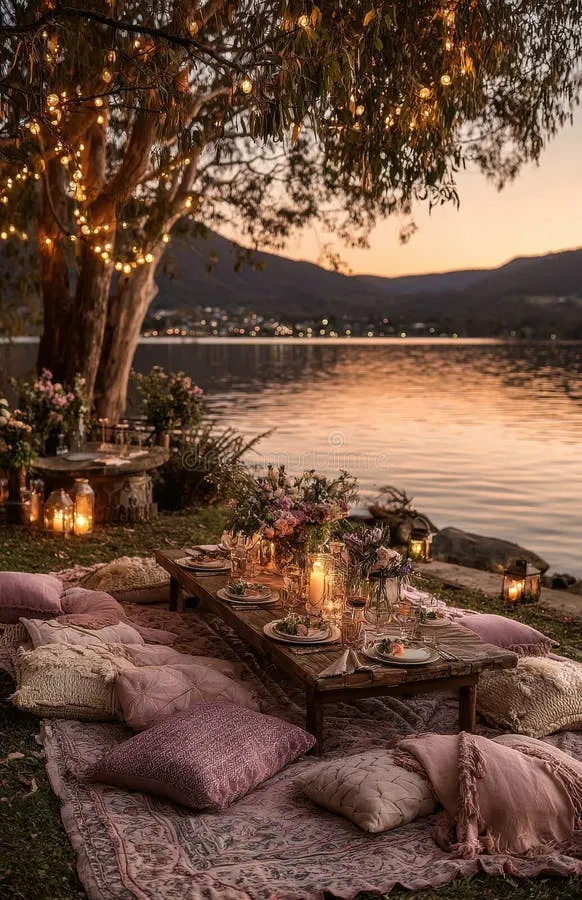
Photo: elegant outdoor lakeside dinner party at dusk long table string lights, via thumbs.dreamstime.com
The brief arrived at a Traverse City architecture studio in the form of a single paragraph. The client, a Chicago finance executive acquiring a parcel on Lake Leelanau, did not ask for a certain number of bedrooms or a square footage target. He asked for an evening: twenty guests, early October, sunset at 6:47 p.m., dinner served as the last light left the water. Build the house around that.
It sounds eccentric. It is, in fact, becoming one of the most quietly influential briefs in American residential design.
The Evening as Program
Architects have long organized homes around morning routines, work habits, or the path of the sun. What distinguishes the new approach is its specificity. Rather than designing generically for "entertaining," a growing cohort of homeowners and their design teams are scripting a signature occasion — the harvest dinner, the fireside tasting, the midsummer soirée — and resolving every architectural decision against it.
The results read less like houses and more like stage sets with extraordinary production values. Dining pavilions oriented not to the view in general but to the precise sightline of an August sunset. Boathouse lounges acoustically tuned for conversation, with ceilings shaped to carry a toast across forty feet without amplification. Kitchens positioned not for convenience but for choreography, allowing a chef to plate a course while remaining part of the evening rather than exiled from it.
"The question we ask now is not 'where should the dining room go?'" says one designer working on lakefront commissions in northern Michigan and Wisconsin. "It's 'where does the memory get made?' Everything else is logistics."
The Pavilions of the New Hospitality
The most visible expression of the trend is the standalone dining structure. On the finest lake properties, the formal dining room is migrating outdoors — or rather, into a third category that is neither inside nor out. Glass-walled pavilions with retractable walls, timber-framed great tables under deep eaves, and terraced shorelines with integrated hearths have become the gravitational center of the plan.
The logic is sensory as much as social. A dinner beside water engages what psychologists of place call the full experiential register: the sound of the lake replacing recorded music, the temperature shift as evening arrives, the gradual blue-to-amber performance of the sky. No interior, however accomplished, can replicate it. The best new pavilions are engineered to capture it while offering the comfort of a great room — radiant floors for shoulder-season dinners, concealed weather screens, lighting systems tuned to candlelight color temperature so the transition from dusk to dark never breaks the spell.
Boathouses, meanwhile, are undergoing their own reinvention. The upper level, once a dusty bunkroom, is increasingly conceived as the estate's most atmospheric entertaining space: a low-lit lounge above the water, whiskey service at one end, a long table at the other, the lake itself as the ceiling's reflection.
Logistics Behind the Romance
What the guest never sees is the infrastructure that makes the evening effortless — and this is where the trend reveals its seriousness. Estates designed around hospitality now specify service circulation as rigorously as any hotel: discreet catering kitchens adjacent to but separate from the show kitchen, freight pathways that move wine and firewood without crossing guest sightlines, dock access that lets arriving guests step from boat to terrace without a single visible stair or gate.
Climate control extends outdoors. Overhead radiant heaters, windbreak plantings positioned by seasonal prevailing-wind studies, and retractable enclosures have pushed the reliable outdoor entertaining season on northern lakes from twelve weeks to nearly six months. For owners who measure a property by the evenings it can deliver, that arithmetic is decisive.
A Doctrine, Not a Gimmick
Skeptics will note that a house built around a party is still a house built around a party. But the doctrine's deeper logic is sound: it forces clarity. Every great estate, the argument goes, has a purpose it serves supremely well, and the families commissioning these homes would rather name that purpose at the outset than discover it by accident.
There is also a quieter emotional calculus. The owners of these properties are, overwhelmingly, people whose calendars are not their own. The single perfect evening is not frivolous; it is scarce. Designing a home around it is simply an acknowledgment that the rarest luxury on any lake is not the water frontage or the square footage. It is the evening when everyone you care about is present, the light is falling exactly as hoped, and nothing — nothing — needs to be improvised.
The finest lakefront architecture has always aspired to that condition. What is new is the willingness to admit it out loud, and to draw the plans accordingly.