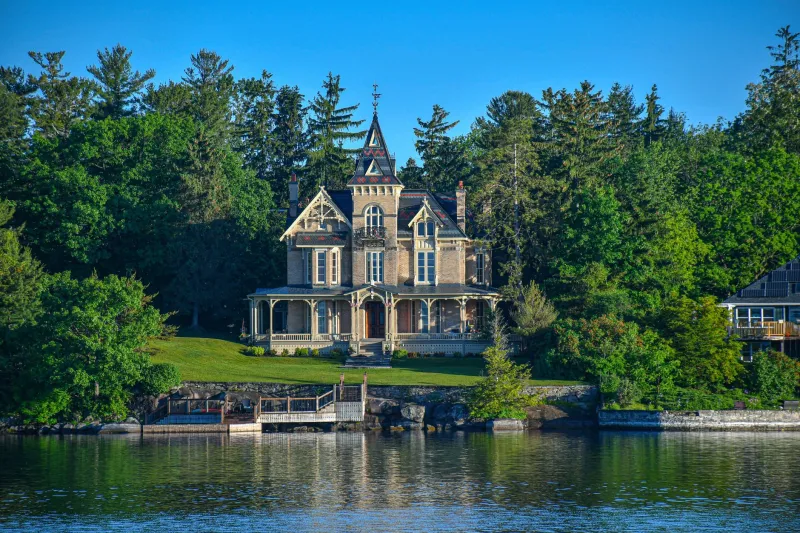
Where the Boardroom Meets the Shore: How America's Most Powerful Executives Are Relocating Their Command Centers to the Water's Edge
For decades, the lake estate occupied a singular role in the vocabulary of American wealth: it was the place one went to stop working. A deliberate counterweight to the pressures of the boardroom, the waterfront property existed to provide distance from professional obligation. That understanding is now being quietly, and rather decisively, dismantled.
Across the premier lakefront markets of the United States — from the Adirondacks to Lake Tahoe, from Minnesota's Boundary Waters to the storied shores of Lake Geneva in Wisconsin — a new architectural typology is taking shape. The ultra-high-net-worth principal is no longer building a retreat from power. He or she is building a retreat for it.
The Architecture of Authority
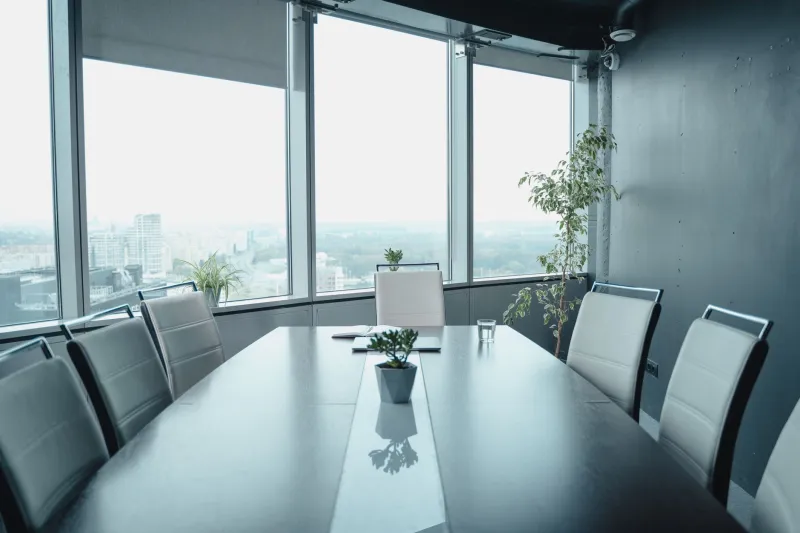
The purpose-built executive suite within a private estate is not, at its core, a home office. That distinction matters enormously to the architects and interior designers who are shaping this emerging category. Where a home office accommodates work, a command center commands. The difference is expressed in every dimension: ceiling height, structural acoustics, the orientation of windows toward the water, the placement of a conference table relative to the natural light.
Leading residential architects working in this space describe a consistent brief from their clients. The professional environment must project authority to those who enter it — whether visiting partners, general counsel, or foreign investors attending a working session — while simultaneously delivering the psychological benefits of the natural landscape beyond the glass. The waterfront is not merely a backdrop. It is, in the language of these designers, a strategic asset.
"There is a reason that heads of state have historically conducted diplomacy in environments of extraordinary natural beauty," notes one New York-based architect whose practice specializes in high-net-worth residential commissions. "The landscape communicates something about the individual who inhabits it. Our clients understand this intuitively."
Infrastructure Beneath the Surface
The visual drama of a boardroom cantilevered over a private cove is only the most visible expression of what these estates require. Beneath the architectural statement lies an infrastructure investment that rivals the communication systems of mid-sized corporate campuses.
Secure, redundant internet connectivity — often achieved through a combination of fiber, satellite backup, and private cellular networks — is now considered a baseline requirement rather than a premium feature. Soundproofed conference rooms are equipped with broadcast-quality audiovisual systems capable of supporting simultaneous participation across multiple time zones. Dedicated server rooms, climate-controlled and physically secured, occupy discreet spaces within the estate's lower levels or outbuildings.
For clients whose professional activities carry regulatory or security dimensions — whether in finance, defense contracting, or government-adjacent industries — the specifications become considerably more demanding. Faraday shielding, electromagnetic interference mitigation, and biometric access protocols are increasingly requested as standard elements of the executive suite program. The estate, in these instances, must satisfy the same security standards as a classified government facility, housed within an environment of uncompromising residential elegance.
The Psychology of Productive Water
There is a compelling body of research supporting what many of these homeowners have long understood empirically: proximity to water enhances cognitive performance. The emerging field of neuroarchitecture — which examines how built environments influence neurological and psychological states — has begun to quantify what lakefront estate owners have experienced anecdotally for generations.
Decision-making under conditions of natural light, open water views, and reduced ambient noise has been associated with measurably improved outcomes across a range of cognitive tasks. For executives managing portfolios, partnerships, or enterprises of genuine complexity, this is not an abstract amenity. It is a competitive advantage.
The most sophisticated estate programs now incorporate this research directly into their architectural logic. Conference rooms are oriented to maximize exposure to natural light and water views during peak cognitive hours. Transitional spaces — covered terraces, screened pavilions positioned at the water's edge — are designed to facilitate the kind of informal, reflective conversation that rarely occurs in a formal urban office setting. The estate is engineered to produce clarity.
Prestige Without Displacement
One of the more consequential aspects of this trend is what it reveals about the evolving geography of American business. The assumption that consequential commercial activity requires physical proximity to a major metropolitan center is being tested, and in many cases overturned, by principals who have discovered that the estate can serve as a more effective professional environment than any downtown tower.
Visiting counterparties, rather than resisting the journey to a lakefront location, frequently find the experience memorable in ways that a standard conference room cannot replicate. The estate provides a context that a hotel ballroom or corporate headquarters simply cannot manufacture: the sense of having been admitted to something genuinely private, genuinely exceptional.
For the estate's owner, this dynamic translates into a form of soft influence that experienced dealmakers recognize immediately. Conducting business within one's own home, on one's own terms, in an environment of unambiguous personal achievement, establishes a conversational register that is difficult to replicate anywhere else.
The Future of the Lakefront Command Center
As the boundaries between professional and personal life continue to evolve for America's most accomplished individuals, the demand for estates that can sustain both without compromising either will only intensify. The architectural profession is responding with programs that treat the executive suite as a first-class component of the residential brief — not an afterthought, not a converted bedroom, but a space designed from the foundation up to support the full weight of a consequential professional life.
The lake estate, in this reading, is not retreating from the world. It is, rather, drawing the world toward it — on its own terms, at its own pace, and with a view that no urban address can match.