The Art of Absence: How America's Most Discerning Homeowners Are Designing Spaces That Silence the Digital World
There is a particular irony at the heart of the modern luxury estate. The same homeowner who commissions a $40,000 home automation system—one that orchestrates lighting, climate, security, and entertainment with a whisper or a gesture—is increasingly asking their architect for something that system cannot provide: a room where none of it works.
Across the United States, from the lakefront compounds of the Pacific Northwest to the sprawling estates of Palm Beach and the canyon retreats of Santa Barbara, a sophisticated countermovement is reshaping how ultra-high-net-worth Americans conceive of domestic space. Privacy, stillness, and the deliberate absence of digital intrusion have emerged as the defining luxury markers of a new residential era.
The Paradox at the Center of the Smart Home
The modern luxury residence has, for the better part of two decades, been defined by its technological intelligence. Integrated systems that anticipate the occupant's needs, biometric security that eliminates the friction of keys and codes, and climate controls that respond to circadian rhythms have all become standard vocabulary in high-end architectural briefs.
Yet the architects and interior designers who serve this market report a meaningful shift in client priorities. Where conversations once centered almost exclusively on what a home could do, they now increasingly involve what a home can prevent. The question is no longer only how seamlessly a residence can connect its occupants to the world—but how completely it can insulate them from it.
"The clients who were earliest to embrace full home automation are often the same clients now requesting analog sanctuaries," observes a pattern noted consistently among luxury residential architects. "They've had total connectivity. Now they understand, viscerally, what it costs them."
Faraday Rooms and the Architecture of Interference
At the technical frontier of this movement sits the Faraday cage room—a space whose walls, ceiling, and floor are lined with conductive mesh or metallic shielding that blocks all electromagnetic signals. Originally an industrial and governmental privacy tool, the concept has found an unlikely second life in the residential sector.
In practice, a Faraday-shielded room within a luxury estate functions as an absolute signal void. No cellular data, no Wi-Fi, no Bluetooth, no satellite communication penetrates its walls. The effect is total and immediate: upon entering, every device carried by the occupant falls silent. Notifications cease. The ambient hum of digital life—so constant it has become nearly imperceptible—simply stops.
The applications vary by client. Some commission these spaces as dedicated meditation or breathwork studios, where the absence of signal reinforces the discipline of mental stillness. Others use them as high-security boardrooms for sensitive business discussions, where the assurance of zero electronic eavesdropping is architecturally guaranteed rather than merely assumed. Still others design them as sleeping chambers, motivated by a growing body of wellness research examining the relationship between electromagnetic exposure and restorative sleep quality.
The construction of a properly specified Faraday room within a luxury residence commands a significant premium—estimates from specialized contractors range from $50,000 to well above $200,000 depending on room size and shielding specification—but demand has grown substantially enough that several boutique architectural firms now list the service as a standard offering.
The Analog Library as Social Statement
Not every expression of digital retreat requires shielded copper mesh. Across the estates of the American affluent class, the analog library has undergone a striking renaissance—not as a nostalgic affectation, but as a deliberate architectural and cultural declaration.
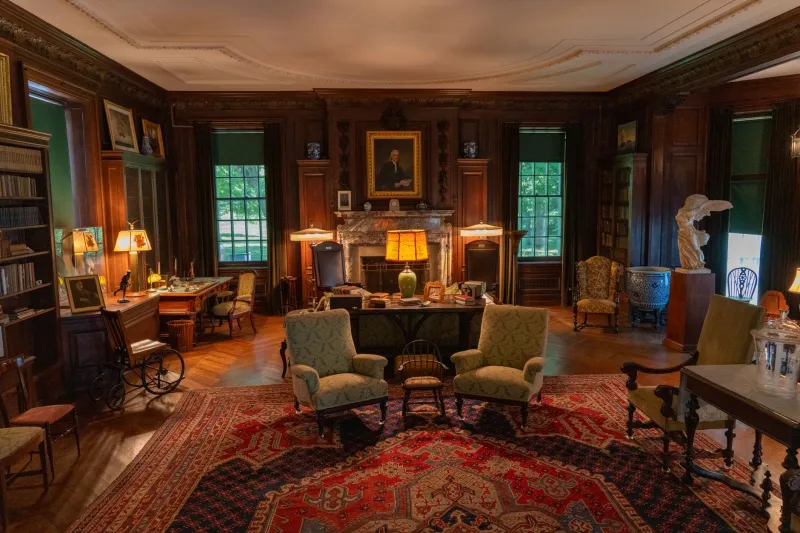
The contemporary luxury library, at its most considered, is designed with a near-religious intentionality. Physical volumes, carefully curated rather than merely accumulated, line walls of hand-finished millwork. Writing surfaces are appointed with quality stationery and fountain pens. Reading chairs are positioned in relation to natural light rather than screen proximity. Critically, these rooms are often specified without a single power outlet visible, and technology is either absent or entirely concealed—a choice that signals, to any visitor, that this space operates by different rules.
The social dimension of this choice is not incidental. Among peer networks of the ultra-wealthy, the analog library has acquired a quiet prestige that the home theater—once the definitive status room—has somewhat relinquished. It communicates not just wealth, but a particular kind of intellectual self-possession: the confidence to be unreachable.
Wellness Architecture and the Offline Body
The convergence of luxury residential design with the broader wellness movement has provided additional momentum to the offline sanctuary trend. Architects specializing in what the industry now terms "wellness architecture" increasingly treat digital disconnection not as a technical specification but as a foundational health principle.
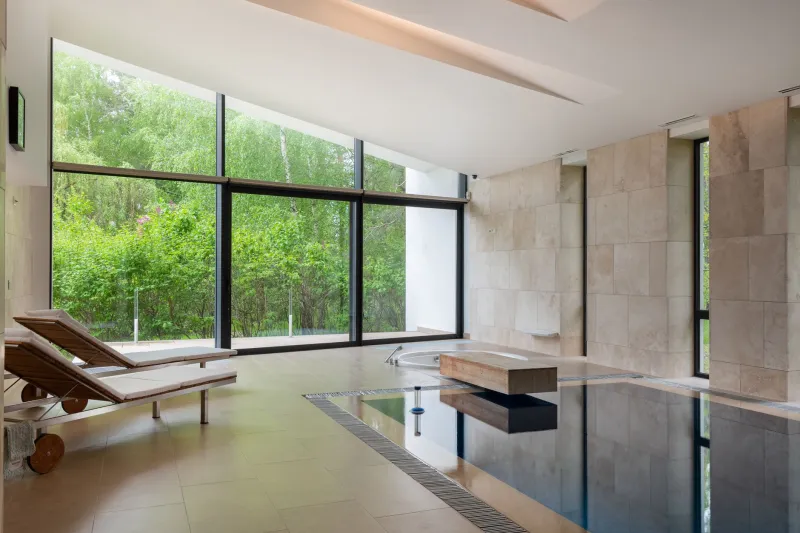
This philosophy manifests across a range of spatial typologies within the luxury estate. Spa wings designed with circadian lighting systems that mimic natural daylight cycles—but contain no screens. Yoga and movement studios where the acoustic design prioritizes silence and where the only technology present is, perhaps, a single analog clock. Outdoor pavilions and garden rooms positioned and landscaped to feel genuinely removed from the residence's technological infrastructure.
The underlying premise, embraced by both wellness practitioners and the architects who serve this market, is that the body and mind require periods of genuine signal absence—not merely reduced stimulation—to achieve the deeper registers of rest and recovery that define true well-being. In this framing, the offline room is not a deprivation but a restoration.
When Privacy Becomes Architecture
Beyond wellness, there is a harder-edged motivation driving some of the most sophisticated requests in this space: the desire for privacy in an era when privacy has become genuinely difficult to achieve.
For individuals whose professional lives, financial decisions, and personal communications exist in a state of perpetual potential exposure, the home has acquired new significance as the last defensible private domain. Designing that domain to actively resist surveillance—whether from external actors, corporate data collection, or the ambient monitoring of smart-home systems themselves—has become a serious architectural priority.
This concern extends to the smart-home systems that define the luxury residence. A growing number of high-net-worth homeowners are requesting what designers describe as "privacy-first" automation architecture: systems that process data locally rather than transmitting it to cloud servers, that offer physical override mechanisms for every connected device, and that include clearly demarcated zones where no automated system operates at all.
The result is a new typology of luxury home that holds two seemingly contradictory ambitions in productive tension—the hyper-connected estate and the sovereign retreat—allowing its occupants to move fluidly between total integration and total withdrawal, according to the demands of their lives and the rhythms of their attention.
The Quiet Room as Ultimate Amenity
In the broader context of luxury residential development, the emergence of the digital sanctuary represents something more than a design trend. It reflects a meaningful recalibration of what affluence is understood to provide.
For most of the 20th century, luxury was defined by access and abundance—more space, more materials, more options, more connection to the world's finest things. The 21st century has complicated that calculus. When access to information, entertainment, and communication is effectively universal, the ability to selectively withdraw from all three acquires a scarcity value that no amount of bandwidth can replicate.
The quiet room, in this sense, is not a rejection of technology. It is technology's most sophisticated application: a space designed with precision and intention to deliver the one experience that no device, however advanced, can manufacture on its own.