The Blue Mind Advantage: How Water Views Are Quietly Transforming the Science of Luxury Home Design
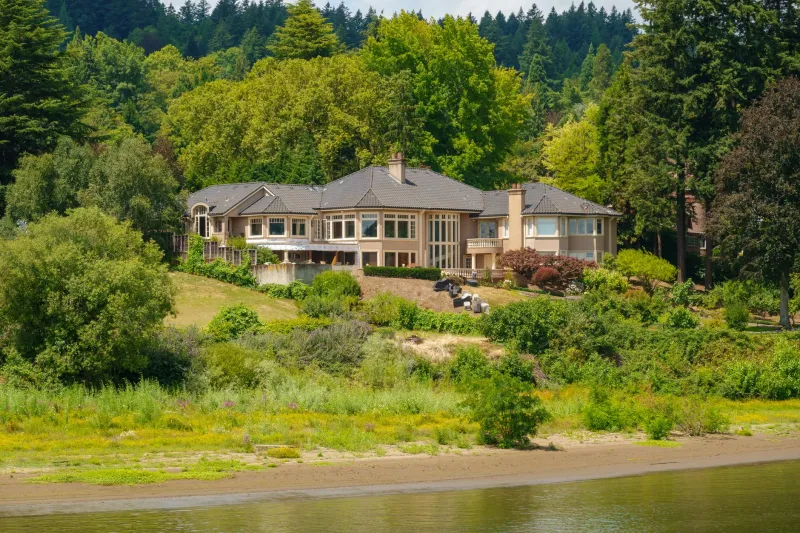
For decades, the premium commanded by lakefront and waterfront properties has been attributed to the self-evident: the view is beautiful, the access is rare, and scarcity drives value. These explanations are accurate, but they are also incomplete. A more precise and compelling account is now emerging from the intersection of neuroscience, environmental psychology, and luxury residential design—one that reframes the water view not merely as an aesthetic distinction, but as a measurable contributor to human health, cognitive performance, and emotional well-being.
America's most sophisticated homeowners are paying close attention.
What the Research Is Beginning to Confirm
The concept of "blue mind"—a term popularized by marine biologist Wallace J. Nichols in his landmark 2014 study of the same name—describes the mild meditative state that water induces in the human brain. Subsequent research has expanded considerably on this foundation. Studies conducted at institutions including the University of Exeter and the Blue Health consortium in Europe have demonstrated that individuals living within visual proximity to water report statistically lower levels of psychological distress, higher life satisfaction scores, and measurably reduced cortisol output compared to those without such access.
The mechanism, researchers suggest, is partly neurological and partly evolutionary. The human visual cortex responds to the gentle, non-threatening movement of water—its reflections, its rhythmic surface changes, its soft luminosity—by downregulating the threat-detection systems of the amygdala. The result is a neurochemical environment more conducive to creative thought, restorative rest, and emotional regulation. In practical terms, a well-positioned lake view may accomplish what sophisticated wellness infrastructure—dedicated meditation rooms, sound-dampening architecture, biophilic interior systems—often strains to replicate.
For luxury homeowners who have invested substantially in the pursuit of residential well-being, this research carries immediate and concrete implications.
Architecture That Listens to the Science
The most forward-thinking luxury architects working in the American lakefront market are no longer treating water views as a passive backdrop. They are designing around them with the same deliberate intentionality they might apply to acoustic engineering or climate resilience.
This shift manifests in several specific design disciplines. Orientation strategy—the precise positioning of a structure relative to the water—has become a primary concern at the earliest stages of estate planning. Rather than defaulting to southern exposure or maximizing square footage, leading architects are modeling solar angles, seasonal light migration, and reflection patterns across a full calendar year before a foundation is poured. The goal is to ensure that the water view is not incidentally visible from key rooms, but is instead a continuous, dynamic presence integrated into the daily rhythms of the home.
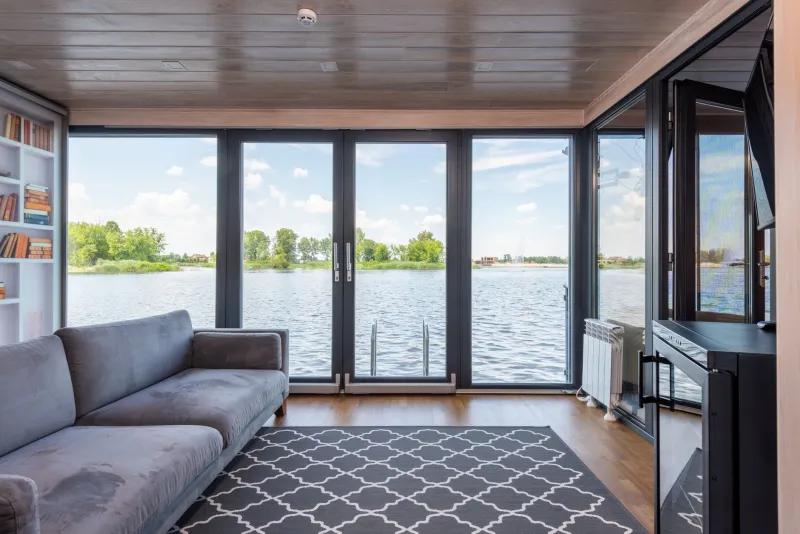
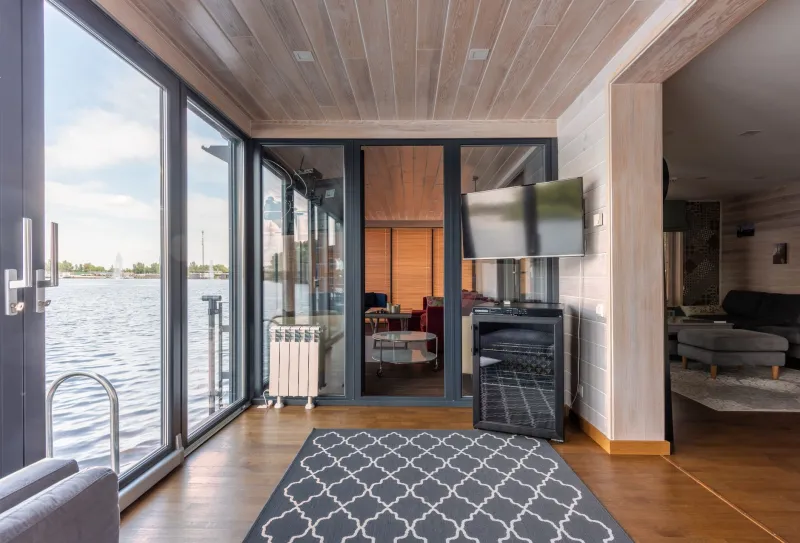
Glazing technology has advanced in parallel. Floor-to-ceiling thermally insulated glass systems, once primarily valued for their aesthetic transparency, are now specified with explicit reference to their capacity to deliver unobstructed, undistorted water views from the interior. Frameless corner glazing—eliminating the visual interruption of structural columns at critical vantage points—has become a signature feature of the most considered lakefront estates. The effect is not merely visual openness; it is the deliberate dissolution of the boundary between the psychological interior of the home and the restorative exterior environment.
Room sequencing has also been reconsidered. Architects are increasingly positioning primary sleeping quarters and private study spaces—the rooms most associated with cognitive recovery and deep focus—toward the water, while locating more socially active spaces, including formal entertaining areas, to receive secondary views. The logic is straightforward: the neurological benefits of water proximity are most valuable in the moments of solitude and restoration that define the private life of the home.
The Reflection as a Design Element
Perhaps the most nuanced development in this emerging discipline is the treatment of water's reflective quality as an active design element rather than an atmospheric accident. The way in which a lake surface mirrors morning light into the interior of a home—casting slow, shifting luminosity across ceilings and walls—has begun to be understood as a form of dynamic environmental enrichment with genuine physiological consequences.
Neuroscientists studying the effects of non-uniform, slowly shifting light patterns on human cognition have found that such conditions support alpha brainwave activity—the neural signature associated with relaxed alertness, creative ideation, and what researchers sometimes describe as a state of effortless attention. The reflected shimmer of a lake surface, it turns out, produces precisely this quality of light with a consistency and subtlety that artificial lighting systems struggle to approximate.
Some of the most accomplished residential designers working in the American lakefront market have begun to account for this phenomenon explicitly. Interior material selections—the finish of ceiling surfaces, the reflectivity of wall treatments in water-facing rooms—are now sometimes calibrated to amplify and distribute reflected water light rather than absorb or interrupt it. The result is an interior environment that feels, in ways difficult to articulate but easy to experience, fundamentally alive.
What Discerning Buyers Are Prioritizing
Among high-net-worth buyers actively seeking lakefront estates in premier American markets—from the Adirondack shorelines of upstate New York to the glacial lakes of the Pacific Northwest and the spring-fed waters of the Texas Hill Country—the conversation around water views has evolved considerably. Where buyers once asked primarily about unobstructed sightlines and navigable water access, they are increasingly asking more precise questions: From which rooms is the water visible at dawn? How does the view change across seasons? Is the primary bedroom oriented to receive morning light off the water?
These are not merely aesthetic preferences. They reflect an emerging buyer sophistication informed, in part, by the same body of research that is reshaping architectural practice. Homeowners who have experienced the cumulative effect of sustained water proximity—the quality of sleep, the ease of focus, the reduction of ambient stress—understand that they are not simply purchasing a view. They are investing in a daily environmental condition with consequences for their health, their productivity, and their fundamental sense of well-being.
An Investment With Invisible Returns
The financial case for lakefront property has always rested on scarcity and desirability. What the emerging science of environmental psychology adds to this case is a more precise account of why the desirability is so durable—and so difficult to replicate through any other means.
No amount of interior design excellence, no wellness amenity, no technological sophistication can substitute for the sustained, neurologically active presence of water in the visual field of a home. It is an advantage that is, by definition, site-specific. And in a market where the most discerning buyers are increasingly attentive to the distinction between properties that are merely extraordinary and those that are genuinely irreplaceable, this quality of place may be the most consequential differentiator of all.
At Villa du Lac, this understanding has always been foundational. The water is not the backdrop to the estate. In the most essential sense, it is the estate itself.