Engineered Quiet: How Acoustic Design Has Become the Defining Luxury of America's Finest Estates

There is a particular quality of silence that only money—and considerable expertise—can manufacture. Not the silence of vacancy, nor the muffled hush of heavy curtains drawn against a street, but a complete, enveloping stillness that seems to exist outside the ordinary world. In America's most exceptional residences, this caliber of quiet is no longer incidental. It is engineered, specified, and commissioned with the same deliberate intention applied to a bespoke kitchen or a climate-controlled wine cellar.
Acoustic design—long the province of concert halls and recording studios—has arrived in the luxury residential market with remarkable sophistication. For homeowners who have curated every other dimension of their living environment, the sonic character of a home has emerged as the final, most intimate frontier.
The Architecture of Stillness
At its most fundamental level, acoustic luxury is about control. The ability to determine precisely what one hears—and what one does not—within the walls of a private residence represents a form of dominion over one's environment that resonates deeply with the sensibilities of discerning homeowners.
Achieving that control demands intervention at the structural level. Acoustic engineers working on high-end residential projects typically begin with the building envelope itself, treating walls, floors, and ceilings not merely as physical boundaries but as acoustic instruments. Double-stud wall assemblies, which create an air gap between interior and exterior wall layers, interrupt the transmission of sound vibrations before they can migrate through a structure. Resilient channel systems—thin metal strips that decouple drywall from the framing behind it—prevent impact noise from traveling through solid materials. In the most rigorous applications, entire rooms are constructed as independent structures within structures, their floors floating on isolation pads engineered to absorb vibration at specific frequencies.
The science involved is genuinely complex. Sound travels through buildings in two distinct ways: through the air as airborne sound, and through solid materials as structure-borne vibration. Addressing both simultaneously requires layered strategies, and the most accomplished acoustic consultants approach each room as a unique acoustic problem rather than applying a single universal solution.
Materials That Listen
The material palette of acoustic luxury is expanding rapidly, driven by advances in both engineering and aesthetics. Early soundproofing solutions often prioritized performance over appearance, producing interiors that felt institutional rather than refined. Today's options represent a convergence of acoustic efficacy and design elegance that would have been difficult to achieve a generation ago.
Mass-loaded vinyl, a dense, flexible membrane installed within wall assemblies, provides exceptional sound isolation without the bulk of concrete or masonry. Acoustic plaster systems—applied as a seamless finish that conceals the complex assemblies behind them—allow walls and ceilings to perform acoustically while presenting a surface of flawless luxury. Specialty glass, incorporating laminated interlayers tuned to specific frequency ranges, permits the expansive glazing that defines contemporary estate architecture without sacrificing sonic privacy.
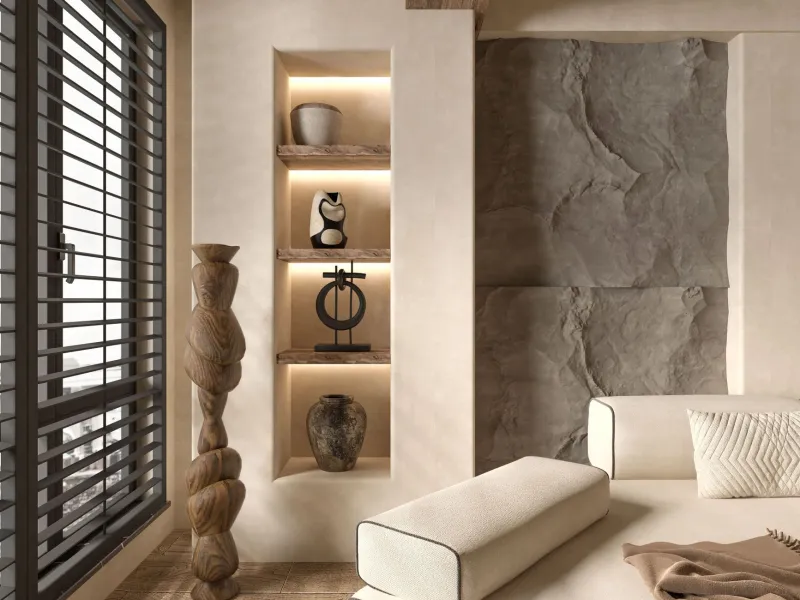
Absorptive materials, which manage the acoustic character within a room rather than simply blocking exterior intrusion, have undergone a similar transformation. Panels clad in hand-stitched leather, custom textiles, and even natural stone composites now serve acoustic functions while contributing to a room's visual narrative. In the finest estates, the distinction between acoustic treatment and interior design has effectively dissolved.
Rooms Designed for a Single Purpose
Perhaps nowhere is the investment in acoustic excellence more apparent than in purpose-built spaces designed to achieve a singular sonic ideal. The home theater remains the most prominent expression of this commitment. At the upper tier of the residential market, these spaces are engineered to specifications that rival professional screening facilities, with reverberation times calculated to fractions of a second, speaker placement determined by acoustic modeling software, and every surface calibrated to deliver an experience that commercial venues rarely match.
Yet the home theater is only one chapter in a longer story. Meditation rooms and private wellness sanctuaries—spaces designed to facilitate genuine psychological retreat—are increasingly specified with acoustic isolation as a primary design parameter. For homeowners who maintain demanding professional lives, the ability to enter a room that is genuinely sealed against the noise of the surrounding world carries a value that transcends the quantifiable.
Music rooms represent another category of particular refinement. Whether designed to accommodate serious amateur musicians or to provide an ideal listening environment for recorded sound, these spaces demand acoustic conditions that standard residential construction cannot produce. Variable acoustic systems—mechanically adjustable panels and diffusers that allow a room's sonic character to be tuned for different musical genres or listening preferences—are appearing with growing frequency in estates built for clients with sophisticated musical sensibilities.
The Invisible Luxury
What distinguishes acoustic design from many other expressions of residential luxury is its invisibility. A hand-painted ceiling, a rare marble floor, a museum-quality art installation—these elements announce themselves immediately to any observer. The acoustic excellence of a home, by contrast, reveals itself only through experience. It is felt before it is understood, perceived as an unusual sense of ease and calm before it is recognized as the product of deliberate engineering.
This quality of invisible luxury holds particular appeal for a segment of the market that has grown weary of conspicuous display. For these homeowners, the knowledge that their residence performs at a level imperceptible to most visitors—that the silence they inhabit each morning is the result of extraordinary technical achievement—carries its own quiet satisfaction.
Acoustic consultants who specialize in residential work frequently describe the moment when clients first experience a completed acoustic environment as one of the most affecting in their professional practice. The response is almost universally the same: a pause, a perceptible relaxation of the shoulders, and a quality of presence that the noise of ordinary life tends to preclude.
An Investment in Daily Life
For prospective buyers evaluating luxury properties, acoustic quality is increasingly a factor that warrants direct investigation. The sonic character of a home—its susceptibility to traffic noise, the audibility of mechanical systems, the degree to which sound travels between rooms—has a material effect on the quality of daily life that is difficult to overstate once experienced.
Estates designed with acoustic excellence as a guiding principle represent a commitment to inhabitation at its most considered. They reflect an understanding that luxury, at its most meaningful, is not about what a home displays but about how it feels to live within it—day after day, in the ordinary and extraordinary moments that constitute a life well lived.
At Villa du Lac, we regard acoustic design as one of the most authentic expressions of residential excellence: a discipline that serves the resident rather than the observer, and that transforms the act of coming home into something genuinely restorative.