Beneath the Surface: How America's Most Sophisticated Estates Are Elevating Hidden Infrastructure Into Defining Luxury
There is a quiet revolution unfolding beneath the manicured grounds and behind the hand-plastered walls of America's most exceptional residences. It does not announce itself through grand architectural gestures or artfully curated interiors. It operates silently, invisibly, and with a precision that most guests will never perceive. Yet for the country's most discerning homeowners, this invisible layer—the infrastructure that governs how an estate breathes, powers itself, and sustains life within its walls—has become one of the defining measures of true luxury.
For decades, the conversation around high-end residential properties centered on what could be seen: the sweep of a grand staircase, the provenance of imported stone, the geometry of a lakefront elevation. Today, a more nuanced understanding of estate value has taken hold. The homeowners who define the leading edge of American luxury are asking a different set of questions. Not only what does this property look like, but how does it function when the power grid fails, when drought conditions tighten municipal water supplies, or when a discerning owner simply demands that every element of their home perform at the same level of excellence as its architecture.
The answer, increasingly, lies underground.
Geothermal Heating and Cooling: The Estate's Quiet Climate Intelligence
Among the infrastructure investments gaining the most traction in elite residential circles, geothermal heating and cooling systems stand apart for their combination of performance, sustainability, and sheer elegance of principle. By drawing on the earth's stable subsurface temperature—typically between 45 and 75 degrees Fahrenheit depending on geography—these systems deliver remarkably consistent climate control without the visual intrusion of conventional HVAC equipment or the operational inefficiency that accompanies it.
For large estates, particularly those situated on expansive lakefront or rural properties where land is not a constraint, geothermal loop fields can be installed with minimal disruption to the landscape above. The mechanical room, once a purely utilitarian afterthought, is now designed with the same attention to finish and organization as a professional kitchen or a private wine cellar. Some homeowners have gone further still, commissioning custom cabinetry, integrated lighting, and climate-controlled environments for mechanical spaces that a facilities manager might maintain with genuine pride.
Beyond the aesthetic, the operational independence that geothermal systems confer carries its own form of prestige. In regions prone to extreme weather—the upper Midwest, the mountain West, the Gulf Coast—freedom from dependence on external fuel delivery is not merely a convenience. It is a statement of self-sufficiency that aligns naturally with the broader values of today's estate owner.
Private Water Systems: Purity as a Point of Distinction
The relationship between exceptional homes and exceptional water is older than the modern luxury market. What has changed is the sophistication with which today's estate owners are approaching water quality, supply, and treatment as integrated design considerations rather than afterthoughts.
Private well systems, once associated primarily with rural practicality, have been reimagined for the luxury context. Whole-property water purification installations now encompass multi-stage filtration, ultraviolet sterilization, and mineral-balancing systems that deliver water calibrated not simply to regulatory standards, but to the specific preferences of the household. Some installations include dedicated lines for drinking water, irrigation, pool and spa systems, and even the estate's wine cellar humidification—each managed independently and monitored through integrated home management platforms.
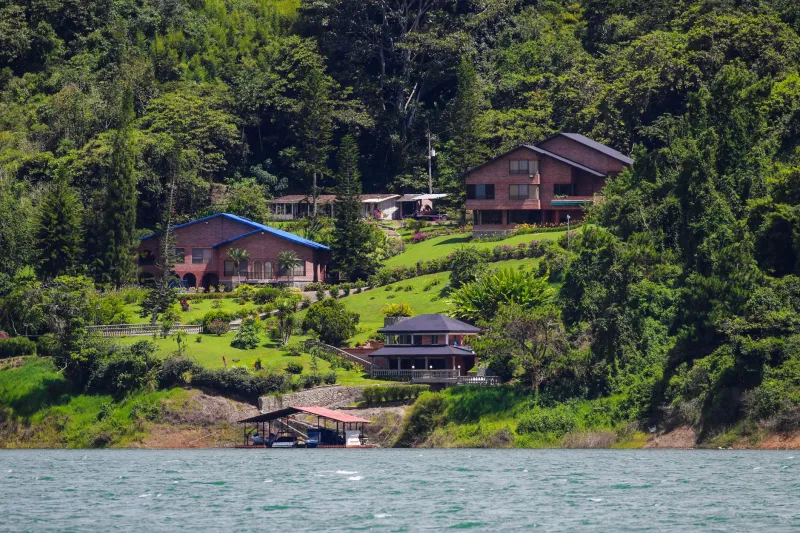
On lakefront properties in particular, where proximity to natural water sources is a central part of the estate's appeal, private water systems serve an additional purpose. They allow owners to draw on and responsibly manage a resource that is already woven into the character of the land, adding a layer of meaning to the infrastructure investment that purely municipal alternatives cannot provide.
Power Independence: The New Standard of Residential Resilience
If there is a single infrastructure category that has captured the imagination of luxury homeowners across the country most forcefully in recent years, it is energy independence. The combination of whole-home battery storage, on-site generation—whether solar, wind, or micro-hydro depending on the property's natural assets—and intelligent energy management systems has made genuine off-grid or grid-supplemental operation not only feasible but architecturally seamless.
The most thoughtfully executed installations are invisible by design. Solar arrays are integrated into rooflines or positioned over outbuildings and motor courts rather than interrupting primary elevations. Battery storage systems are housed in purpose-built spaces adjacent to mechanical rooms, finished to the same standard as the rest of the estate's service areas. Generator systems—once the province of industrial aesthetics and diesel fumes—have been replaced in many estates by quiet, natural gas or propane-fueled standby units capable of sustaining full household operation indefinitely, with automatic transfer switches that engage before an occupant is even aware of a grid disruption.
The result is an estate that performs with absolute consistency regardless of external conditions. For families who entertain frequently, who maintain year-round occupancy, or who simply hold their environment to an uncompromising standard, this level of operational certainty is not a luxury feature in the supplementary sense. It is foundational.
Underground Utilities and the Uninterrupted Landscape
The visual grammar of a great estate depends in no small part on what is absent from the view. Overhead utility lines, transformer boxes, and surface-mounted equipment are the enemies of a composed landscape, and the most meticulous estate owners have long understood that burying utilities entirely is among the most cost-effective investments available in terms of its impact on overall property presentation.
Contemporary underground utility projects go well beyond simple electrical burial. Fiber optic networks, low-voltage lighting infrastructure, irrigation control systems, and security cabling are now routinely installed in coordinated conduit systems that anticipate future needs and allow for upgrades without landscape disruption. Some estates include underground utility corridors—essentially service tunnels—that allow technicians to access and maintain systems without disturbing finished grounds or hardscape.
This level of planning reflects a maturity of thinking about the estate not simply as a collection of beautiful spaces, but as a managed environment designed to sustain its quality over generations.
Infrastructure as Legacy
The shift in how America's most sophisticated homeowners regard their properties' utility systems reflects something deeper than a trend toward technical sophistication. It speaks to a changing conception of what luxury itself means—one in which resilience, independence, and long-term performance carry as much weight as beauty and provenance.
An estate that can generate its own power, purify its own water, manage its own climate, and present an unblemished landscape to the world regardless of what is happening beyond its gates is not merely a beautiful property. It is a self-contained world, designed to endure.
At Villa du Lac, we recognize that the most exceptional homes are defined by the full depth of their quality—from the materials that meet the eye to the systems that sustain life within. In that sense, the invisible infrastructure of a great estate is not hidden at all. It is simply waiting to be understood.