Letting the Water Keep Its Edge: A Case for Waterfront Homes That Barely Touch the Shore

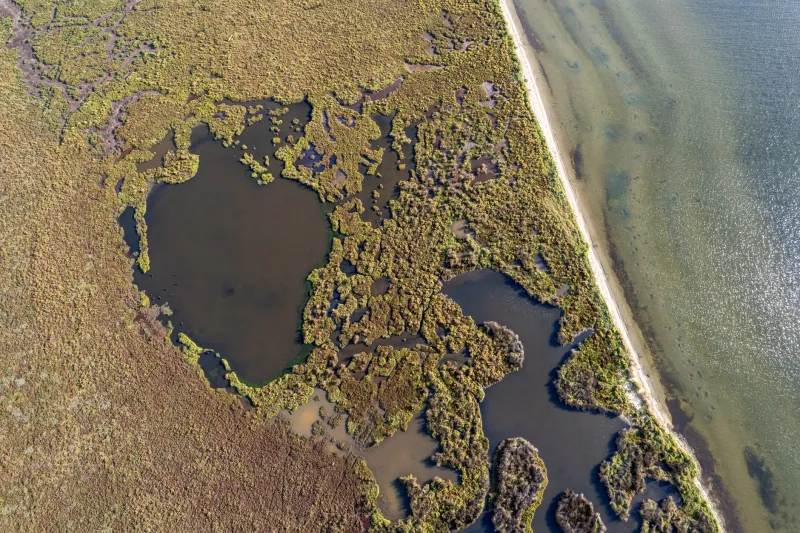
Photo: BLMIdaho, Public domain, via Wikimedia Commons
Let us begin with a confession shared by nearly everyone who has bought, sold, or appraised premium lakefront property: we have spent a century mistaking infrastructure for amenity. The dock — that procession of pressure-treated planks marching into the water — has functioned as the lakefront equivalent of the driveway gate, a status marker so automatic that its absence reads, to some buyers, as a defect.
It is time to argue the opposite. On the finest lakes in America, the dock is increasingly the least luxurious object on the property. And the homes that understand this are quietly outperforming.
The Hidden Ledger of Hardscape
Consider what a typical dock actually costs its owner. Financially, there is the build, the seasonal install and removal, the insurance, the storm exposure — and, on lakes with water-level fluctuation, the recurring arithmetic of a structure that is either too dry or too submerged for months at a time. Environmentally, shoreline hardscaping degrades the littoral zone: the shallow-water habitat where a lake's ecology does its quiet work. A dock shades out vegetation, concentrates boat wake, and signals to every subsequent owner that the shoreline is a machine for boat storage rather than a living edge.
Aesthetically, the case is starker still. Photograph the great lakefront estates of the last fifty years — the ones that command premiums across market cycles — and notice what is missing. The houses that age into icons are those that sit beside the water rather than atop it, that let the shoreline remain a shoreline.
The Counterexample Problem
None of this means boats disappear. It means the boat question is answered with more intelligence than a plank. The estates doing this well share several moves.
Boathouses, where tradition demands them, are being designed as architecture first — structures whose mass, roofline, and materials belong to the house, with the boat bay as one room among several. On Wisconsin's Geneva Lake and North Carolina's Lake Toxaway, the best recent examples are indistinguishable in quality from the main residence, and they enhance rather than interrupt the shoreline.
Where a dock is genuinely unnecessary, the sophisticated alternative is the shared or off-site slip: a marina berth or community mooring a golf-cart ride away, paired with a shoreline left to native plantings and a natural sand beach. The boat remains an hour's walk from the cocktail hour, which — the owners of these properties will tell you — is precisely the point. The lake is the view, the swim, the stillness. The boat is an errand with a motor.
What Buyers Are Actually Paying For
The financial argument is emerging from brokerage data as much as philosophy. Waterfront appraisers increasingly note that unimproved or minimally improved shorelines — those retaining natural vegetation, beaches, and grade — command premiums on resale, particularly as shoreline regulations tighten across the Midwest and Northeast. A seawall that seemed prudent in 1990 is a permitting problem in 2025. A dock is a depreciating asset on a depreciating edge. A restored, natural shoreline is an appreciating one.
There is also a regulatory current beneath all of this. Water levels are less predictable than they were a generation ago; storm intensity is up; permitting for new shoreline structures is harder nearly everywhere. The estates built for the next fifty years are those that need the water's permission for as little as possible.
The New Ideal
The contrarian position, stated plainly: the best waterfront home is the one that touches the water as lightly as a hand on a shoulder. One path to a beach, kept natural. One structure on the shoreline at most, and only if it earns its place as architecture. Everything else — the boat, the toys, the machinery of lake life — lives discreetly elsewhere.
This is not austerity. It is the recognition that on a truly great lake property, the water is the amenity, and every plank driven into it is a small subtraction from the thing you paid for. The finest estates of the coming decade will be judged not by how far they extend into the lake, but by how gracefully they stop at its edge.