When Walls Become Galleries: The Architecture of Private Art Collection in America's Finest Homes
There is a particular kind of stillness that settles over a room when a Flemish oil painting from the seventeenth century occupies the same space where one takes morning coffee. It is not the hushed reverence of a museum corridor, nor the transactional atmosphere of an auction house. It is something altogether more intimate — a daily negotiation between personal history, aesthetic conviction, and the quiet authority that only great art can confer upon a space.
Across the United States, a growing cohort of ultra-high-net-worth homeowners is pursuing precisely this experience. No longer content to relegate their collections to storage facilities or loan them indefinitely to institutions, these collectors are commissioning residences — and in many cases, fundamentally reimagining existing ones — as privately curated environments where living and collecting are inseparable pursuits.
The Collector's Residence as Cultural Statement
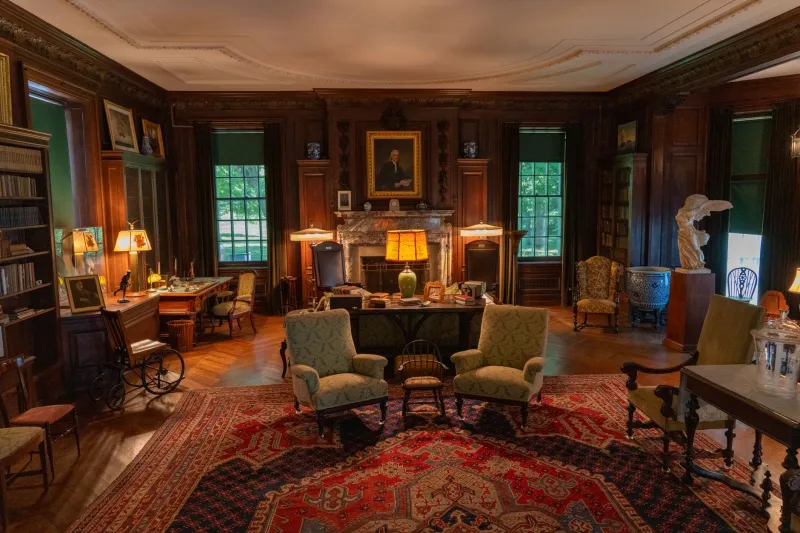
The impulse to surround oneself with objects of beauty and historical significance is hardly new. The great American industrialists of the Gilded Age — the Fricks, the Gardners, the Mellons — built private palaces that were as much repositories of culture as they were homes. What distinguishes today's collector-homeowner, however, is the integration of contemporary architectural thinking with the functional demands of serious collection management.
Where earlier generations displayed art as a signal of arrival, today's discerning homeowners approach their collections with a more nuanced intentionality. The residence becomes a curatorial statement — a reflection of intellectual depth, aesthetic sensibility, and a long view of value that transcends mere financial calculation. Antiquities from pre-Columbian Mesoamerica may occupy the same carefully considered sight line as a major post-war American canvas, not by accident, but through deliberate architectural choreography.
Architects and interior designers who specialize in this space speak of the "collection-first" design philosophy: a methodology in which the requirements of the art inform every structural and spatial decision, rather than the collection being accommodated as an afterthought within a conventionally designed home.
Engineering the Ideal Environment
Beauty, in this context, demands engineering. The preservation of significant works — whether a sixteenth-century Flemish panel, a rare Pre-Raphaelite canvas, or a collection of ancient Roman bronzes — requires environmental conditions that are both precise and consistent. This is where the private collector's residence diverges most dramatically from the conventionally appointed luxury home.
Climate control in a serious collector's residence operates at a level of specificity that far exceeds standard HVAC considerations. Relative humidity must be maintained within a narrow band — typically between forty-five and fifty-five percent — to prevent the expansion and contraction cycles that cause paint layers to crack and wooden supports to warp. Temperature stability is equally critical, with fluctuations of even a few degrees over short periods capable of causing irreversible damage to sensitive works.
Leading residential architects working in this specialty frequently collaborate with museum conservators to design what are essentially hybrid environments: spaces that function as elegant, livable rooms while maintaining the controlled conditions of a professional conservation facility. Dedicated air-handling systems with HEPA filtration, ultraviolet-filtering glazing on windows, and fiber-optic or LED lighting systems calibrated to minimize ultraviolet and infrared output are now standard specifications in residences designed for serious collectors.
Beyond climate, the structural requirements of significant collections demand attention. Large-scale sculptures and antiquities require reinforced flooring capable of supporting considerable concentrated weight. Partition walls may be engineered specifically to accommodate hanging systems rated for substantial loads, with concealed mounting hardware that preserves the visual cleanliness of the display surface.
Security as Architecture
The security infrastructure of a private museum residence operates on a principle that would be familiar to any institutional curator: protection must be comprehensive, layered, and — critically — invisible. The finest collector's homes achieve a seamless integration of sophisticated security systems within architecturally refined environments, such that the apparatus of protection never intrudes upon the experience of the collection itself.
State-of-the-art systems in this category extend well beyond conventional alarm infrastructure. Vibration sensors embedded within walls and flooring can detect the subtlest disturbance. Thermal imaging cameras monitor spaces continuously without the visual disruption of conventional CCTV equipment. Biometric access control governs movement through the residence's most sensitive areas, while dedicated secure rooms — reinforced vaults concealed behind bookshelves or paneled walls — provide climate-controlled overnight storage for the most valuable pieces.
Many collector-homeowners also maintain direct relationships with specialized fine art security consultancies, whose professionals conduct regular vulnerability assessments and advise on everything from staff vetting protocols to the management of visitor access during private events. The result is an environment of profound security that never announces itself — an invisible architecture of protection that allows the collection to remain the sole focus of attention.
Designing for the Living Collection
Perhaps the most compelling challenge in designing a private museum residence lies in maintaining the fundamental character of a home. Institutional galleries, however beautiful, are not domestic spaces. The private collector's residence must accomplish something far more difficult: it must feel genuinely inhabited, warm, and personal, even as it meets the exacting standards of professional collection management.
The most accomplished practitioners of this discipline achieve this balance through a deep attention to sequence and scale. A residence designed around a significant collection is, in a meaningful sense, a carefully scripted journey. Arrival spaces establish a tone — perhaps a monumental sculpture or a single commanding canvas — before transitioning into more intimate rooms where smaller works invite prolonged engagement. Scale relationships between objects and architectural volumes are calibrated with precision, ensuring that neither the art nor the architecture overwhelms the other.
Natural light, when employed thoughtfully, remains one of the most powerful tools available to the collector-architect. North-facing clerestory windows, light wells, and carefully positioned skylights can introduce the quality of diffused natural illumination that renders certain works — particularly Impressionist paintings and works on paper — in conditions of extraordinary beauty, while automated shading systems protect against the harmful effects of direct solar exposure.
The Investment Dimension
For all its aesthetic resonance, the private museum residence carries a compelling investment logic as well. The art market, while subject to its own cycles, has demonstrated remarkable long-term resilience, and the integration of a significant collection into a distinguished residential property creates a compound value proposition that neither element achieves independently.
A residence designed to accommodate and showcase a major collection commands a distinct premium in the luxury market. The specialized infrastructure — climate systems, security architecture, reinforced structures, bespoke lighting — represents a substantial capital investment that is recognized and valued by subsequent buyers of comparable sophistication. More significantly, the cultural cachet associated with a home that has housed a distinguished collection lends the property a provenance and narrative that few other features can replicate.
For the collector-homeowner, the private museum residence represents the fullest possible integration of passion and purpose: a space that honors the objects it contains, sustains their condition across generations, and reflects the depth of the vision that assembled them. It is, in the truest sense, a home that lives at the highest register of human aspiration — a place where exceptional objects and exceptional lives are, at last, properly acquainted.