Behind Closed Walls: The Quiet Revolution of Concealed Spaces in America's Finest Residences
There is a particular kind of luxury that cannot be photographed, catalogued, or admired by guests. It exists behind a bookcase that swings silently on a hidden pivot, beneath a wine cellar that descends further than any visitor is invited to follow, or within a corridor that does not appear on any publicly filed floor plan. This is the luxury of concealment—and among America's most discerning homeowners, it has never been more sought after.
The appetite for hidden rooms within high-end residences is no longer a relic of Gothic revival fiction or Cold War paranoia. It is, by all accounts, one of the most compelling and quietly urgent trends reshaping luxury residential design in the United States today. Architects, interior designers, and security consultants from the Hamptons to Beverly Hills report a marked increase in client inquiries for spaces that are, by deliberate intention, invisible.
The Anatomy of Concealment
What exactly are wealthy Americans building behind their walls? The answer is far more varied—and far more revealing—than one might expect.
Panic rooms remain a foundational request, particularly among clients in high-profile industries or those with significant public profiles. Modern iterations bear little resemblance to the stark, utilitarian bunkers of earlier decades. Today's safe rooms are appointed with the same level of refinement as any other room in the house: custom millwork, curated lighting, full communication systems, and furnishings selected with the same deliberation as a primary suite. The goal, as one Los Angeles–based architect put it, is that the room should feel like a retreat rather than a refuge of last resort.
Beyond security, the categories of concealed spaces have expanded considerably. Private wine vaults—distinct from the more visible wine cellars that have long been a hallmark of luxury homes—are increasingly designed to be entirely hidden from view, accessible only to those who know precisely where to look. These are not spaces meant for entertaining; they are personal archives, repositories of collections that may span decades and represent significant financial and sentimental value.
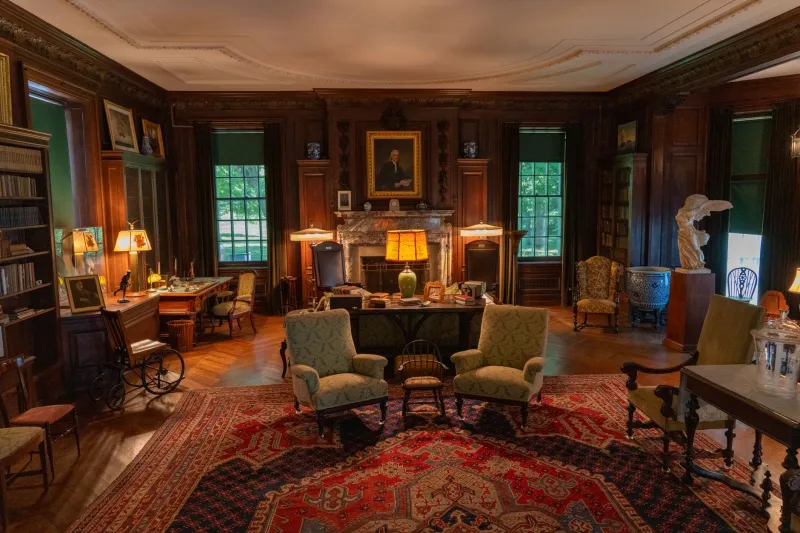
Private home offices and communication suites represent another growing category. As the boundaries between professional and domestic life have blurred, many affluent homeowners have sought spaces where sensitive business conversations, confidential documents, and proprietary technology can exist entirely apart from the rest of the household. A concealed office, accessible through a disguised panel in a library or study, offers a degree of compartmentalization that a conventional home office simply cannot.
Perhaps the most culturally resonant emerging category is the private gallery. For collectors who prefer to keep their holdings away from the scrutiny of visitors—or simply wish to experience art in conditions of their own choosing—a concealed gallery offers both optimal preservation conditions and an intimacy that no public-facing display space can replicate.
The Psychology Behind the Walls
To understand why this trend has accelerated so markedly, it is necessary to consider what has changed in the lives of America's wealthiest individuals over the past decade.
Digital exposure has increased dramatically. High-net-worth individuals now navigate a world in which their residences may be identifiable through satellite imagery, their collections discoverable through social media, and their routines potentially trackable through a dozen different data streams. The desire for concealment within the home is, in part, a direct architectural response to the erosion of privacy in the broader world.
There is also a psychological dimension that several designers describe as the appeal of the sovereign space—a room that belongs, in the most complete sense, only to its owner. In an era of open floor plans and communal living areas designed for maximum transparency and social flow, the hidden room represents a counterpoint: a space that is entirely one's own, undiscovered by even the most attentive guest.
"There is something deeply satisfying to clients about the idea of a space that simply doesn't exist to anyone else," notes a New York–based residential designer who specializes in high-security luxury properties. "It's not about secrecy for its own sake. It's about owning something that is genuinely, completely private in a world where privacy has become extraordinarily rare."
The Engineering of Invisibility
The technical execution of these spaces has become an art form in its own right. The most accomplished concealed rooms are distinguished not merely by their existence, but by the seamlessness with which they disappear into their surroundings.
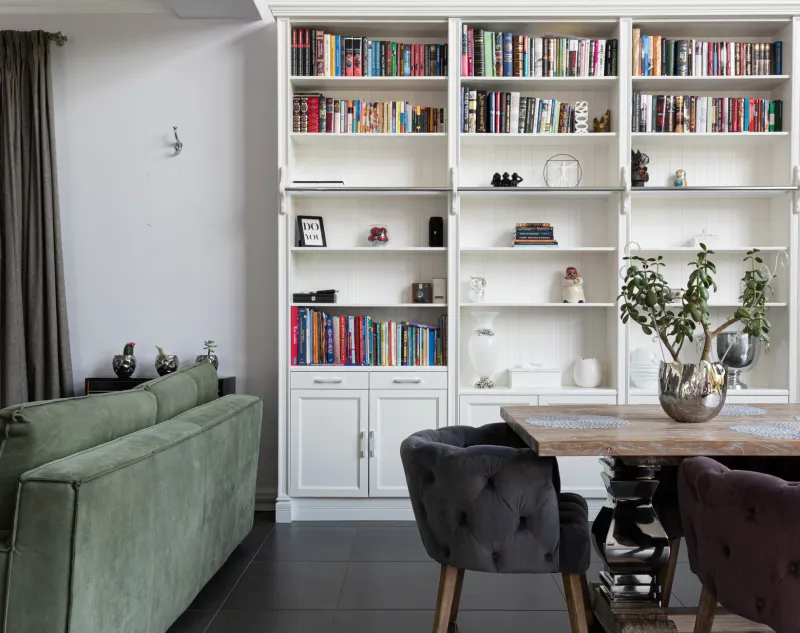
Bookcase doors remain a classic mechanism, though contemporary versions operate with a precision and silence that their predecessors could not achieve. Magnetic latching systems, hydraulic hinges, and flush-mounted hardware allow a fully loaded bookcase to swing open at the touch of a concealed button or a specific sequence of actions—pulling a particular volume, pressing an unmarked panel, or entering a code into a device disguised as something else entirely.
Wall panels finished in the same material as the surrounding room—whether lacquered plaster, stone cladding, or fabric-wrapped board—represent a more contemporary approach, particularly suited to minimalist interiors where a bookcase would appear incongruous. The challenge here lies in maintaining the visual continuity of grout lines, fabric seams, or stone veining across what is, in fact, a door. The craftspeople capable of executing this work flawlessly are few, and their services are commensurately valued.
For below-grade spaces, concealed staircases and elevator shafts present their own engineering considerations. Climate control, ventilation, and acoustic isolation must all be addressed without revealing the room's existence through mechanical noise or temperature differentials that a perceptive visitor might notice.
Discretion as a Design Principle
What unites all of these spaces is a principle that Villa du Lac has long recognized as fundamental to truly exceptional residential design: the most refined luxury is often the least visible. The hidden room is, in this sense, the ultimate expression of a broader philosophy—that a home's most valuable qualities are not always those that announce themselves.
For prospective buyers and those commissioning new builds, the integration of concealed spaces requires early-stage planning. Retrofitting these elements into an existing structure is possible, but significantly more complex and costly than incorporating them into the original design. The most sophisticated estates being developed today treat concealed spaces not as afterthoughts, but as core components of the architectural program—planned alongside primary suites, entertaining areas, and service corridors with equal care and intention.
In this regard, the hidden room is not merely a feature. It is a statement about what its owner values most: not the display of wealth, but the quiet, unassailable security of possessing something that is entirely, irreducibly one's own.