Divided to Conquer: Why America's Most Sophisticated Families Are Trading the Grand Estate for a Constellation of Properties

For generations, the American estate carried a particular grammar. It was singular, sprawling, and unmistakable—a statement of arrival expressed in acreage, square footage, and architectural grandeur. The grander the property, the more eloquently it spoke of the family within. That grammar, it turns out, is being quietly rewritten.
Across the country's most exclusive real estate markets—from the lake country of Michigan and Minnesota to the coastal corridors of the Carolinas and the mountain corridors of Colorado—a notable cohort of ultra-high-net-worth families is abandoning the single-compound model in favor of something more nuanced: a deliberate constellation of smaller, strategically positioned properties. The shift is neither accidental nor driven by constraint. It is, in nearly every case, a calculated decision rooted in financial intelligence, lifestyle refinement, and a more sophisticated understanding of what legacy actually requires.
The Limitations of the Monolith
The traditional estate, however magnificent, carries structural inefficiencies that only become apparent at scale. A 20,000-square-foot primary residence demands continuous staffing, year-round maintenance costs, and a logistical infrastructure that operates regardless of whether the family is in residence. During the eight or nine months a year when many such properties sit largely unoccupied, they continue to consume resources at nearly the same rate as when fully inhabited.
There is also the matter of utility. A singular grand estate, by its nature, is designed to serve every purpose simultaneously—entertaining, retreat, recreation, family gathering, and professional hosting—often serving none of them with particular elegance. The rooms are too numerous, the grounds too vast, and the experience too diffuse to consistently deliver the intimacy and intentionality that discerning homeowners increasingly demand.
Perhaps most significantly, the monolithic estate concentrates risk. Market fluctuations, regulatory changes, environmental exposure, and shifting neighborhood dynamics all bear down on a single asset. When that asset represents the majority of a family's real property holdings, the vulnerability is considerable.
The Distributed Model: Architecture as Strategy
The emerging alternative—what some wealth advisors are beginning to call the micro-compound constellation—reframes property ownership as a portfolio discipline rather than a singular acquisition. Families operating under this model typically maintain two to four properties, each scaled between 4,000 and 9,000 square feet, positioned across different geographic markets and designed with a specific residential purpose in mind.
One property might serve as the primary family hub, located near schools, professional centers, or extended family networks. Another might be positioned on a lakefront or mountain setting, purpose-built for seasonal retreat and recreational living. A third could occupy a warmer climate—Florida, Arizona, or the Carolina coast—designed for winter residency and intergenerational gathering. Each property is staffed and maintained proportionally to its use, allowing operational costs to flex with actual occupancy rather than running at full capacity regardless of need.
The financial logic is compelling. Across multiple states, families gain access to a range of domicile and tax planning strategies unavailable to single-state property holders. States with no income tax, favorable estate tax structures, or advantageous treatment of real property can be incorporated into a family's residential strategy in ways that produce meaningful long-term savings. When coordinated with a qualified tax counsel and estate planning team, the distributed model can meaningfully reduce the overall tax burden on generational wealth transfer.
Intimacy as a Luxury Metric
Beyond the financial calculus, families who have made this transition frequently cite something less quantifiable: the quality of experience within each property improves dramatically when a home is designed for a specific purpose rather than engineered to serve every conceivable function.
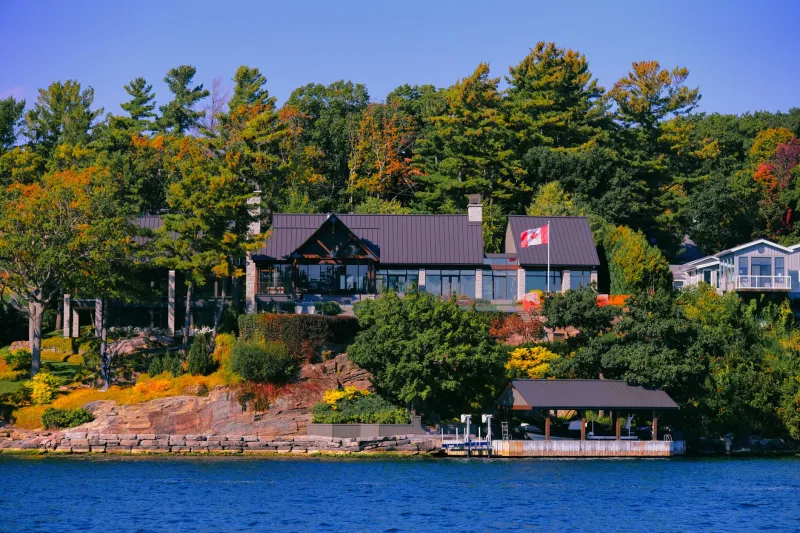
A lakefront property of 5,500 square feet, designed expressly for summer living and family recreation, can deliver an immediacy and warmth that a sprawling 18,000-square-foot compound never quite achieves. Every room is relevant. Every space is inhabited. The property breathes with the family rather than dwarfing them within it. This is not a concession to smaller scale—it is, for many families, the discovery that scale had been working against them all along.
There is also the matter of staff dynamics. Smaller, purpose-driven properties tend to attract and retain household staff more effectively than massive estates that demand generalist versatility across an exhausting range of responsibilities. A well-run five-bedroom lakefront home with a dedicated team of three or four specialists often delivers a more refined residential experience than a grand estate reliant on a rotating cast of twenty.
Legacy Reconsidered
Perhaps the most profound implication of the distributed model concerns inheritance. The traditional estate, when passed to the next generation, frequently becomes a source of conflict rather than cohesion. Siblings with different geographic lives, different financial situations, and different relationships to the property find themselves co-owners of an asset that serves none of them optimally while burdening all of them operationally.
The constellation model offers a more elegant inheritance architecture. Multiple properties can be allocated individually, placed into separate trust structures, or assigned to different branches of a family with minimal friction. Each heir receives an asset calibrated to their life rather than a fractional claim on a monolith calibrated to no one's life in particular. The properties remain family assets without becoming family obligations.
Estate attorneys working with multigenerational wealth increasingly note that the distributed residential model simplifies succession planning considerably—reducing the likelihood of forced sales, contentious valuations, and the quiet resentments that large shared properties so reliably generate over time.
Selecting the Right Properties for a Constellation
For families considering this transition, the discipline lies in acquisition strategy. Each property within a constellation should be chosen not merely for its intrinsic appeal but for its functional role within the whole. Questions of geographic diversification, climate exposure, proximity to transportation infrastructure, and long-term market fundamentals all bear on the decision.
Lakefront properties, in particular, have proven to be anchor assets within distributed portfolios—offering strong appreciation histories, meaningful lifestyle utility across multiple seasons, and a scarcity dynamic that insulates value over time. Markets along the Great Lakes, the Ozarks, and the mountain lake corridors of New England and the Pacific Northwest have each demonstrated the kind of sustained demand that rewards long-term holders.
The most successful constellations are assembled over time, with each acquisition informed by experience in the ones that preceded it. Families who approach the model with patience and strategic clarity tend to arrive, within a decade, at a residential portfolio that serves every dimension of their lives with a precision that no single property—however magnificent—could have delivered alone.
The grand estate is not disappearing. It is, rather, evolving—dispersed across a thoughtfully curated collection of exceptional homes, each one a chapter in a larger story of how a family chooses to live.