The Price of the View: How America's Most Coveted Lakefront Estates Are Reclaiming Solitude Without Surrendering the Shore
There is a particular tension that settles over certain lakefront estates on a warm Saturday afternoon in July. The water glitters. The dock is perfectly maintained. And yet, a parade of pontoon boats idles just beyond the property line, smartphones raised, capturing images of a home that was designed, at considerable expense, to feel invisible to the world beyond its gates.
This is the waterfront paradox — the quietly frustrating reality that a lakefront estate's greatest asset is also its most persistent vulnerability. Proximity to exceptional water commands premium valuations, attracts sophisticated buyers, and confers a quality of life that few residential settings can rival. It also, in an era of GPS-enabled recreation and social media discovery, invites a degree of uninvited attention that no amount of landscaping has historically been able to fully resolve.
For a growing number of ultra-high-net-worth homeowners, addressing this paradox has become as central to the design brief as the selection of stone cladding or the configuration of the primary suite.
The Anatomy of an Intrusion
Understanding the challenge requires acknowledging its many forms. On America's most celebrated lake systems — from Lake Tahoe and Lake Geneva in Wisconsin to the Finger Lakes of New York and the private enclaves of the Adirondacks — the intrusion rarely arrives as a single dramatic event. It accumulates.
A kayaker who lingers too long offshore. A social media post, tagged with a location, that transforms a secluded cove into a weekend destination. A tour boat operator who incorporates a notable estate into a narrated circuit. A drone, piloted recreationally or professionally, that drifts over a terrace where a family is gathered for dinner.
Each incident, taken individually, may seem minor. Cumulatively, they erode the very quality — genuine, unperformed solitude — that justified the property's acquisition. The irony is acute: the homeowner who paid a premium for water views now finds those views compromised not by the water itself, but by the culture of visibility that surrounds it.
Architecture as the First Line of Defense
The most enduring solutions begin at the design stage, long before a property is occupied. Architects specializing in luxury waterfront residences have developed a vocabulary of strategies that preserve the outward view while substantially diminishing the inward one.
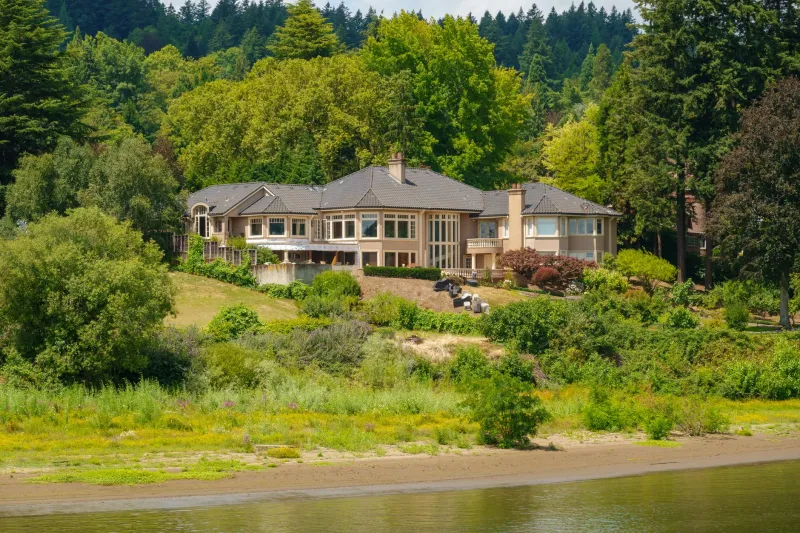
Siting is paramount. Where regulations and topography permit, positioning the principal living volumes at an elevation above the shoreline creates a natural perceptual barrier. A home observed from the water at a steep upward angle reveals far less than one situated at grade. Combined with mature canopy plantings — carefully selected species that screen sightlines without obstructing the homeowner's own views across the water — this approach can render a substantial estate effectively invisible from the lake surface.
Façade orientation matters equally. Glazing that faces the water can be specified with high-performance fritted or tinted glass that reads as opaque from exterior angles while remaining luminous from within. Covered terraces, deep overhangs, and strategically positioned garden walls further compress the zone of visibility without creating the fortress-like aesthetic that contradicts the spirit of lakefront living.
Perhaps most elegantly, some architects have embraced the concept of the "borrowed view" — designing interior sight lines that frame the water through layers of landscape, so that the lake appears as a composed picture rather than an unmediated exposure. The homeowner sees everything. The world outside sees almost nothing.
The Landscape as Architecture
Where the built form reaches its limits, the landscape takes over. Contemporary estate landscape design has evolved well beyond the ornamental, becoming a sophisticated instrument of spatial management.
Native shoreline plantings — sedges, native willows, emergent aquatic grasses — serve a dual purpose. Ecologically, they support the water quality and biodiversity that make premium lake frontage worth preserving. Strategically, they establish a visual and physical buffer zone at the water's edge that discourages casual approach and softens the boundary between the private estate and the public waterway.
Berms, grade changes, and dense hedgerow masses can be deployed further inland to create what landscape architects describe as a "layered threshold" — a sequence of spaces that progressively deepens the sense of enclosure as one moves from the water toward the residence. The effect is one of arrival rather than exposure: the estate reveals itself on its own terms, not on those of a passing boat.
Legal Frameworks and Riparian Rights
Architectural and landscape measures address the visual dimension of intrusion. Legal frameworks address the physical and regulatory one — and in this arena, the rules vary considerably by state and by the specific character of the water body in question.
Riparian rights, which govern a landowner's relationship to adjacent waterways, differ meaningfully between states and between navigable and non-navigable waters. On certain private lakes, homeowners' associations hold collective authority to regulate recreational use in ways that significantly reduce transient boat traffic. On larger, publicly navigable lakes, the parameters are more constrained — though not without recourse.
Private aviation easements, noise ordinances, and local drone regulations have all been employed, with varying degrees of success, to address specific vectors of intrusion. Some jurisdictions permit the establishment of private no-wake zones within defined distances of residential shorelines, reducing both the physical disturbance of passing watercraft and the tendency of recreational boaters to linger at low speed.
For those acquiring property on smaller, privately held water bodies, the legal framework can be considerably more favorable. Deed restrictions, lake association bylaws, and conservation easements can collectively create a regulatory environment that preserves the character — and the privacy — of a shoreline in perpetuity.
The Social Media Dimension
No contemporary analysis of waterfront privacy would be complete without confronting the particular challenge posed by digital discovery. A single viral image of a remarkable estate can generate years of unwanted attention, drawing visitors to a location that was never intended to be a destination.
Some homeowners have responded proactively, working with legal counsel to establish clear intellectual property frameworks around the visual representation of their properties. Others have engaged with local tourism and recreation authorities to ensure that their estates are not incorporated into officially promoted lake tours or digital mapping features.
Perhaps the most effective long-term strategy, however, is the one least dependent on external cooperation: designing a property that is genuinely difficult to photograph compellingly from the water. When architecture, landscape, and siting work in concert, the result is an estate that reads as a whisper from the outside — beautiful in its restraint, but unremarkable as a social media subject. The drama, by design, is reserved entirely for those who have been invited inside.
Reclaiming the Shore
The waterfront paradox, ultimately, is not a reason to abandon the pursuit of exceptional lakefront property. It is a design problem — and like all design problems, it rewards careful thought, expert counsel, and a willingness to invest in solutions that are as refined as the property they protect.
For those who approach the acquisition of a lakefront estate with clear-eyed awareness of these challenges, the rewards remain extraordinary. The water, the light, the particular quality of stillness that only a great lake can provide — these are not diminished by the effort required to preserve them. If anything, the deliberate craft of reclaiming solitude lends the resulting sanctuary a depth of meaning that a more casually acquired property could never quite achieve.
At Villa du Lac, we believe that true luxury is never accidental. It is designed, defended, and — when circumstances demand — reclaimed.